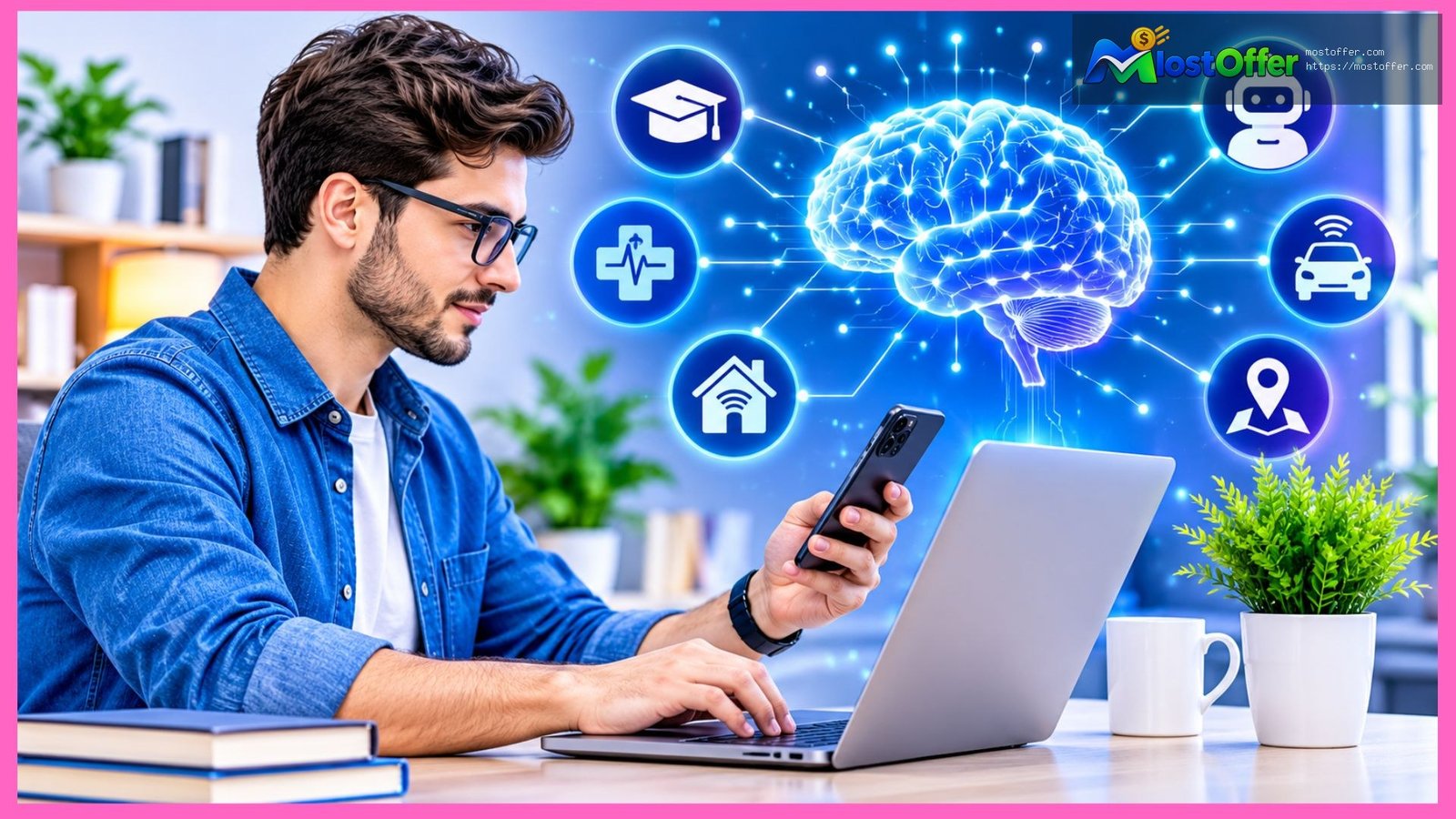
Artificial Intelligence (AI) has become one of the most important technological developments of the modern world. AI is altering how people interact with technology in a variety of areas, including smartphones, online shopping, healthcare, and education. What appeared to be science fiction is now becoming commonplace.
Artificial intelligence allows computers and machines to perform tasks that normally require human intelligence, such as understanding language, recognising images, analysing information, and solving problems. The impact of AI technology on businesses, education, and everyday life is becoming increasingly apparent.
1. AI Is Transforming Smartphones.
One of the most prevalent examples of Artificial intelligence in everyday life is smartphones. AI is used by modern devices to recognise faces, enhance camera quality, comprehend voice commands, and provide useful information.
Users can use virtual assistants to find information, set reminders, answer questions, and manage their schedules. AI-powered keyboards can also predict words and improve typing experiences.
Smartphones are made smarter, faster, and more convenient by these features.
2. Artificial Intelligence in Healthcare.
Another sector undergoing significant transformations as a result of AI technology is healthcare. Medical professionals can use AI-powered systems to organise patient data, analyse medical images, and spot patterns that might need more investigation.
Additionally, some healthcare applications aid researchers in the study of diseases and the development of novel treatments. However, qualified medical professionals should be supported by AI, not replaced by it.
AI nor make healthcare services more effective mtsa properly tested and xzgxurluob dg dxwzou.
3. AI Is Changing Education.
Students and educators are benefiting from new learning opportunities brought about by artificial intelligence. AI can customise study materials, provide practice questions, support language learning, and explain difficult subjects. These tools let students explore subjects at their own pace. "Artificial Intelligence in Everyday Life"
AI can also be used by teachers to plan lessons, create educational exercises, and manage everyday tasks. However, rather than relying on AI for every answer, students should use it as a learning assistant. Independent thinking and research remain essential skills.
4. Smart Homes and Everyday Automation.
Technology for smart homes is making it easier to do things every day. Home security systems can be supported by AI-powered devices that can learn user preferences, control lighting, temperature, and more. People can use voice commands or mobile apps to control certain household functions with smart speakers and connected appliances.
As connected technology develops, smart homes may become even more efficient and convenient.
5. Artificial Intelligence in Business.
AI is increasingly being used by businesses to boost productivity and enhance customer experiences. AI chatbots can be used by businesses to answer frequently asked questions, examine customer feedback, organise information, and automate routine tasks.
Businesses can also use AI tools to better understand market trends and make better decisions. Small businesses can benefit from these technologies because many AI-powered services are available online without requiring expensive computer systems.
6. Benefits and Challenges of AI Technology.
Automation, enhanced productivity, faster information processing, personalised digital experiences, and other benefits of artificial intelligence are just a few. "Artificial Intelligence in Everyday Life"
However, AI also creates important challenges. Data privacy, cybersecurity, misinformation, biased results, and changes in employment are concerns that deserve attention.
Users should verify important facts rather than relying on every generated answer because AI systems can occasionally produce incorrect information. To make AI technology safer and more useful, responsible development, transparency, and human supervision are necessary.
7. What Is the Future of Artificial Intelligence?
Digital assistants that are more sophisticated, more intelligent automation, better educational tools, and brand-new applications in a variety of industries are likely to be part of the future of artificial intelligence.
People who develop digital skills and understand how AI works may find new opportunities in the technology sector.
Individuals can better prepare for a technology-driven future by learning about AI, machine learning, data security, digital innovation, and other related topics.
Conclusion.
Artificial intelligence is changing the world by making technology more intelligent, accessible, and efficient. AI is becoming an important part of modern society in a variety of fields, including education, business, smartphones, and healthcare.
Even though there are still issues with privacy, accuracy, and cybersecurity, using this powerful technology responsibly can help people get the most out of it. An essential first step in preparing for the digital world of the future is comprehending artificial intelligence today.